



About
Al-rafidain of Law Journal (ARLJ) has been published on behalf of the College of Law, University of Mosul, since 1996. We succeeded in re-issuing the journal immediately after the liberation of Mosul City from ISIS in 2017. It is an open-access journal published under the license of Creative Commons Attribution 4.0 International (CC-BY). ARLJ welcomes high-quality submissions, including articles, essays, case notes, comments, and reviews, which focus on Iraqi, Regional, or international legal developments.
It was published simultaneously with the Iraqi scientific journal website IASJ. It has been classified among several internationally Well-known databases, DOAJ and IASJ. With the Impact factor, all research published in the journal obtains the DOI No
. Al-rafidain of law Journal (ARLJ) accepts all manuscripts sent by researchers in Arabic, English and French
Please note: All submissions to the Alrafidain of Law Journal should go through
https://alaw.uomosul.edu.iq/index.php/alaw/index
Open Access Policy
ARLJ is an open-access journal, which means that all articles are available on the internet to all users immediately upon publication, without requiring a subscription to the journal. Thus, all papers published in ARLJ are distributed under the open-access license agreement. Under this license, authors retain ownership of the copyright for their work but allow anyone to download, re-use, re-print, modify, distribute, or copy the content as long as the original authors and source are cited properly. Competing Interest Declaration All authors must include a competing interest declaration on their title page. This declaration will be subject to editorial review and it will be published in the article. Competing interests are situations that could be perceived to exert an undue influence on the content or publication of an author’s work. They may include but are not limited to, financial, professional, contractual, or personal relationships or situations. If the manuscript has multiple authors, the author submission must include competing interest declarations relevant to all contributing authors. Peer Review Process All contributions are subject to a double-blind peer review process. All received manuscripts will be sent to two referees. Authors will be notified whether their papers are accepted for publication or not. The authors whose contributions are accepted for publication will be sent the referee form which is mentioned if revisions are required or if the paper is accepted as it stands. The authors requested to submit revisions for review and will send the new versions of their articles to the editor. The deadline for submitting the revised papers will be mentioned by the editor in the correspondence with the author(s)). All submitted work must not have been published elsewhere or be currently under review for any other publication Criteria:
1. Relevance of theme/s
2 .Originality
3.Argumentative structure & clarity
- Methodological integrity & use of data (if applicable)
5.Use of literature & theory
- Language – the quality of communication The reviewers will provide a score for each criterion, an overall recommendation, and comments. Publication fee Al-rafidain of law Journal is not financially supported by any governmental or non-governmental organization. Therefore, publishing an article in the journal requires a payment of 130000 ID ( 100 U$) as publishing fees.
Frequency: 4 issues per year
Al-rafidain of Law (ARLJ) ARLJ an open-access journal, has been published on behalf of the College of Law, University of Mosul, since 1996. , It is an open-access journal published under the license of Creative Commons Attribution 4.0 International (CC-BY). ARLJ welcomes high-quality submissions, including articles, essays, case notes, comments, and reviews, which focus on Iraqi, Regional, or international legal developments.
. Al-rafidain of Law Journal(ARLJ) accepts all manuscripts sent by researchers in Arabic, English, and French
Current Issue
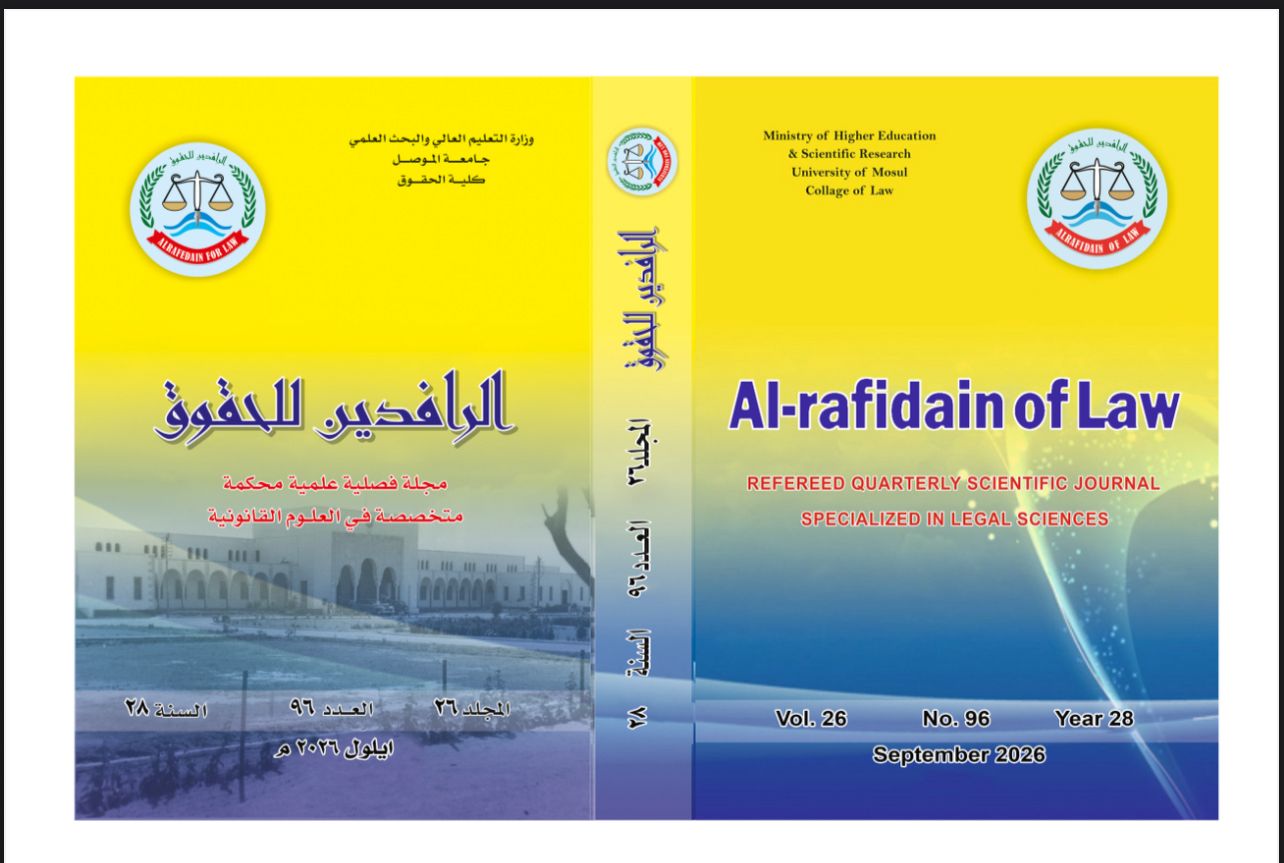
Vol. 26 No. 96 (28)
Vol. 26 No. 96 (28)
Published: 2026-09-01
Contents
Article
Employing artificial intelligence technologies in arbitration processes: a study of Palestinian arbitration law in comparison with the uncitral model law on international commercial arbitration and the rules for expedited arbitration
Osayd Awawda, Nadeen Amro
This research aims to examine the extent to which artificial intelligence (AI) technologies may be integrated into the arbitral process as an alternative means of dispute resolution, with a...
Mortgage of movables (towards a new legal regulation of mortgage in Iraqi law)
Payam Kareem
The provisions of acting in movable assets in Iraqi law allow for the possibility of reconsidering the texts regulating the mortgage of movables, given the incompatibility of the provisions of...
Assessing the Sufficiency of Existing Jordanian Laws to Regulate Blockchain Technology
عمار الرواشده
regulating transactions using blockchain technology, in light of the decentralized nature of this system. The research aims to clarify the legal characterization of blockchain and explain its...
DOI: 10.33899/kcc0wh39
Combining mortgage and guarantee in securing the same debt - an analytical study in Iraqi civil law
Falah Ali
Abstract: This research addresses combining mortgage and suretyship for a single debt, given the legal issues regarding execution order, surety liability, and the impact of mortgage...
DOI: 10.33899/nf1gtb28
Legal security of the unity of the criminal text
Ahmed Mahmoud, Talal Hussein
Legal security constitutes a fundamental pillar of the principle of criminal legality, as it ensures the protection of individual rights and freedoms, The essence of legality is not limited to...
Parallel financial investigation in criminal procedures -A foundational study on the concept and distinction-
Noureddine Mohamed, Abbas Saeed
The concept of parallel financial investigation within the scope of criminal proceedings is defined by a procedure that aims to identify the elements of the financial liability of the accused and...
The effectiveness of the federal integrity commission in light of the obstacles it encounters
Hassan Yahya, Ansam Abdullah
The Federal Integrity Commission is considered one of the most significant oversight bodies established pursuant to Order No. 55 of 2004 (now repealed) and the regulatory law annexed thereto. It...
Climate litigation and its role in achieving
Esraa Ghanem, Fathi Al-hayani
Due to the failure of a number of countries to implement their climate commitments under the Paris Agreement, which aims to limit temperature rise and promote climate and environmental justice,...
BOOK REVIEW
Author review The legal system of commercial companies - A comparative study- Dr. Zaidi Amal
Dr. yaser shakir.m
Abstract: The conglomerate of commercial companies is one of the means of economic concentration that commercial companies resort to. They maintain their independent legal personality in the...